Showing: 1 - 5 of 14 RESULTS
Blog

Is Soybean Oil the Antidote to Sass?

oil in a small bowl next to a wooden spoon holding raw soybeans

Building a strong relationship between humans and horses is crucial for safe and effective horse management. The results of an exciting new study published in the Journal of Equine Veterinary Science showed that serotonin, a chemical in the brain linked to mood and social behavior, plays a key role in how horses interact with people (Kim et al., 2025). 

The study found that adding soybean oil to horse diets boosts serotonin levels, making the horses more friendly and open to human interaction.

The study found that adding soybean oil to horse diets boosts serotonin levels, making the horses more friendly and open to human interaction. It also helps manage stress by keeping cortisol levels stable and improving other stress markers. Friendlier and calmer horses is something we can all appreciate! 

It’s well known that diet affects horse behavior, so, by adding fats like soybean oil to their diet (instead of starch), we have the ability to help reduce their stress, as well as some of the challenging behaviors that accompany stress.

While more research will help us better understand how these fats work, and their long-term effects, the findings from this study highlight the potential of dietary changes for improving the welfare and performance of horses.

Reference:

Kim, S., Choi, Y., Kim, J., Wickens, C., Yoon, M. (2025) Soybean oil supplement induces increased approaching behavior to humans and alters serotonin concentrations in horses, Journal of Equine Veterinary Science, Volume 146,105361, ISSN 0737-0806, https://doi.org/10.1016/j.jevs.2025.105361.

If you would like some help deciphering your horse’s behavior, reach out to Helena, she’d be happy to consult with you!

Blog

Did You Know?

FORAGING is one of the most important natural behaviors horses need to engage in.

Foraging is the process of a horse using its nose to sniff, whiskers to feel, lips to wiggle around, and taste grasses in their environment. Grazing is the act of actually eating the grass. And, while eating is obviously an important thing to do for, you know, survival, the foraging behavior that comes just before the chomping and chewing is vitally important for the horse’s mental health.

If you keep a horse on pasture, they have plenty of opportunity to forage. Yay! Yes, there are challenges with lush grass and easy keeper or metabolic horses, but we have solutions to those problems. If your horses don’t have grass to forage through, here are some helpful hacks that simulate the foraging process and activate happy hormones in your horse’s brain that bring calmness and a sense of satisfaction:

Kick your hay!

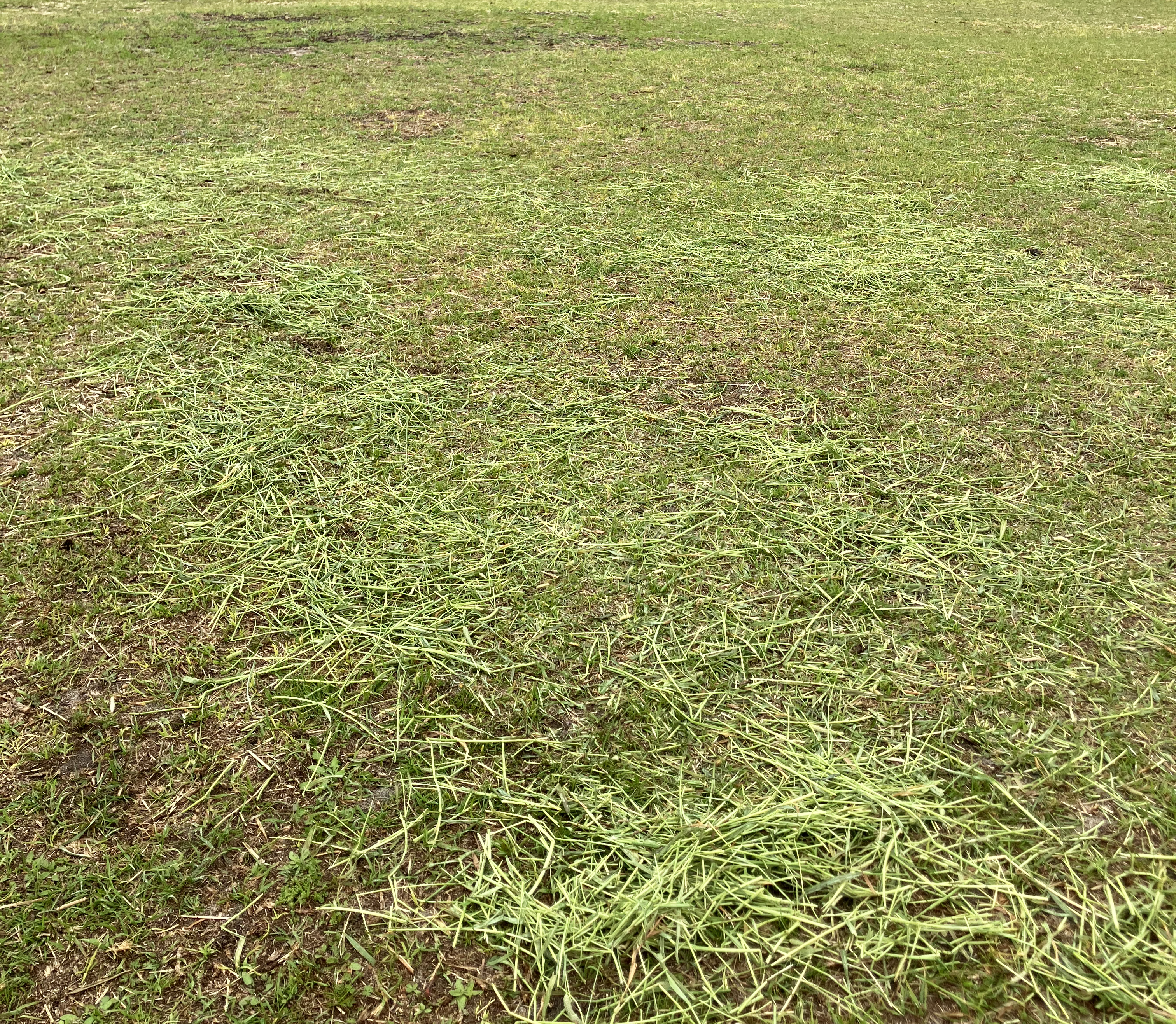
The great thing about square bales is that you can feed flakes. We drop several flakes in the morning and evening while our spring pasture grasses awaken from their long winter nap. The hay is weighed so we can ensure our horses are getting the right amount, then we load it up in the wagon and spread it out in the paddocks. First, we drop a flake on the ground, then kick it as hard as possible. This gets the dust out and spreads the hay along the ground so that our horses have to walk and eat in order to consume all of the hay. Even if the wind picks up strands of hay and spreads them further, that’s okay, because the process of chasing down edible grass (whether fresh or dried) is exactly the kind of foraging behavior we want to encourage in our horses.

Get a Snuffle Pasture
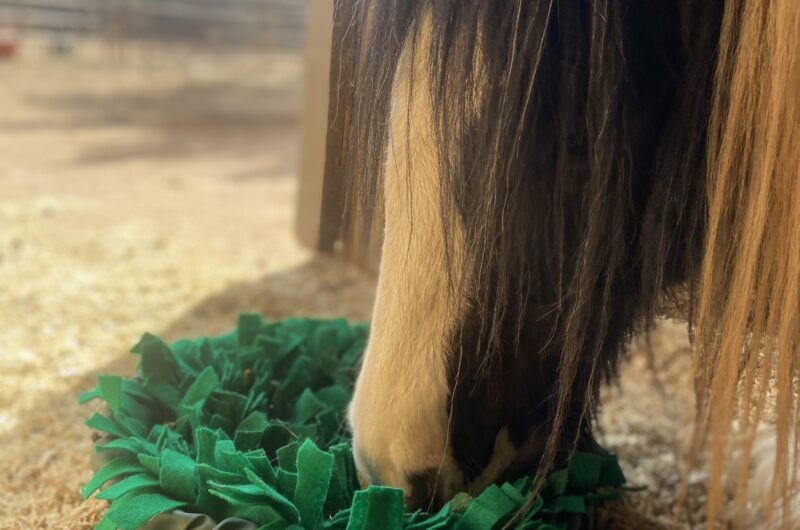
This brilliant feed pan that is enhanced with simulated grass makes foraging through it for grain or treats exactly what horses need to stay sane. It is especially helpful for horses who are still in stalls for most of the day. Use the Snuffle Pasture in between hay or grain feedings when your horse is most likely to show stress behaviors like weaving, cribbing, windsucking, or lip smacking. Snuffle Pasture

Hide healthy treats like carrots, hay pellets, or horse cookies in horse-safe toys.
Anything that allows them to sniff –> bite –> chew –> walk–> sniff –> bite, chew –> walk. It’s the foraging and walking a step or two in between that matters the most.

Rotate your paddocks
Even if you don’t have lush pasture, anything your horse can forage through will support his mental and emotional wellbeing. Try rotating your paddocks every few days so they don’t turn completely to dirt. Even the ability to snuffle through weeds and crabgrass is helpful.

For more information about how you can incorporate habitat features that create calmer horses, contact Helena.

Graphic style 1930s woman holding a phone with expletives talk bubble
Blog Business

Demands for Refunds

Dear Barn Boss,

I run a small boarding and training business in the mid-atlantic. Lessons, shows, and clinics are a part of the services I offer. We do about 6 clinics a year, and they fill up with a mix of my boarders and riders from nearby barns. It’s been fun hosting them. 

One of my boarders is fairly new, she’s a teenager often accompanied by her mom, who is not a horse person. As with many parents of horse-crazy kids, this mom is enthusiastic and happy to be involved in any way she can short of actually riding or handling their horse. Mom signed her daughter up for a clinic we are having with a top-tier professional. We’re about eight weeks out from the clinic date and the mom contacted me to ask for a refund because the daughter was injured and won’t be able to ride in the clinic. 

It is common for clinic and event organizers to have a No Refund policy, and we have one. It’s clearly spelled out on the event registration page and in the email confirmation people get after submitting payment.

When the mom asked for a refund, I sympathized with her dilemma, gently reminded her of our No Refund policy, and made sure she knew that while we couldn’t refund her money, we do allow substitutions. This was not okay with her. She contacted me again to insist that it was easy for us to issue a refund, that substitutions are not good business practices, and that we need to “do the right thing”, which was couched in language that implied she would complain publicly if I didn’t comply with her demand. 

Horse events are tough because, well, horses. I try to be as flexible as my monthly cash flow and business best practices allow. What I can do, is waive the change fees we usually charge when riders swap spots. Since this mom and her very sweet daughter are a part of our barn community, it is difficult for me to stand firm on this for fear of her taking all of her business away and possibly maligning my barn to others. 

How can I politely respond to this customer’s demand for a refund, when all I really want to do is tell her to go kick rocks?

Sincerely,
-Fearful at the Farm


Dear Fearful,

Stop fretting. You already know what you need to do, and what is right for your business.

This customer is new to the horse world, and she doesn’t realize that many of us are familiar and comfortable with swapping out our clinic spot for someone else who wants in. She’ll figure that out eventually. What’s more concerning, is her assumption that issuing refunds is easy for you and then demanding one after you already told her you could not refund her money. Her sense of entitlement does not bode well for a long-term business relationship with you, so be prepared to find a new boarder if she decides to move her horse.

Some people assume that what they want from you is easy to do, when in fact, they have no idea what goes on in your back office or on your balance sheet! Some people also believe that because they can demand a refund from companies like Target and Amazon, that all businesses should follow the same process. Unfortunately, small businesses are rarely in a position to handle the kind of losses these bigger companies can in the name of customer service.

Waiving the change fee is a good consolation prize. While making changes to any event involves time that you could otherwise be using as a billable hour (teaching or coaching, for example), offering to waive that fee shows your flexibility and willingness to keep the business relationship with this customer. But stand firm on your No Refund policy. It is there for a reason.

“Dear Customer,

I completely understand your dilemma. We’ve all been there! Many clinicians and hosting barns don’t allow for changes or any kind, but as a small horse business in close-knit community, we like to offer as much flexibility as possible. While your registration fee can’t be refunded, we can waive the change fee if you find another rider to take your daughter’s spot.”

Be kind. Be firm. Be the boss.

-BB

Behavior Blog

“All Training Methods Can Be Harmful”

Rope halters, patience poles, and clickers, oh my!

A recent discussion about the dangers of rope halters, patience poles, and other forms of restrictive training methods got me thinking. (Can you smell the smoke from there?) Is clicker training really as dangerous as tying a horse to a pole and letting the horse learn through physical and emotional struggle that efforts to escape are futile?

Hmmm. Think about that for a minute. Like, really try to envision the learning process in the horse. Now, close your eyes and imagine that you are tied to a pole by your head. You are confused, possibly frightened, and definitely having a panic attack.

I did this exercise recently, and you know what I thought?

Fuck that shit.

Then I wanted to find the idiot who tied me up and kick ’em in the arse. Or head. Whichever was closest.

While it is possible for all training methods to be done in a way that is harmful to the horse, not all training methods are fair to the animal, let alone effective or humane.

Animal Welfare Science Can Help Us Keep Enjoying Horses

Leveraging scientific research for the improved welfare of domestic horses is the goal of animal welfare science. If we want to continue to enjoy the company of horses, their recreational benefits, and even their commercial value, we must evaluate all methods of shaping behavior–whether those methods are old ones or new ones–from the perspective of the horse, who is an animal. We are not “training horses”, we are shaping the behavior of an ungulate-a hoofed mammal. When we remember that the horse is something more than the label we have given it, a certain measure of respect and consideration seems to take priority in our work with them.

Exonerative Beliefs

Exonerative beliefs are part of a belief system that people develop in order to absolve themselves of blame (Cornish et al., 2018), particularly to overcome the cognitive dissonance associated with the inhumane treatment of animals (Serpell, 2005).

A common phrase we hear that is a classic example of an exonerative belief is: “All bits have the potential to be harmful, it all depends on the skill of the rider.” This is often heard in response to concern about the use of painful bits.

Or this one:

“All training methods have the potential to be injurious to the horse. It all depends on the education of the trainer.” This justification is typically heard from people who have little experience with or knowledge of the scientific application of positive reinforcement.

When you, or someone you know, tries to downplay positive reinforcement, be on the lookout for cognitive dissonance. Do the statements about R+ reflect inner conflict, or ignorance? Or both?

Is Positive Reinforcement More Dangerous Than Other Training Methods?

There is no debate about skill level and training methods. It is common knowledge that inexperience in any endeavor increases risk of failure or injury. This does not, however, exempt certain training methods from being more inherently dangerous than others. Positive reinforcement (aka clicker training), for example, is less dangerous than restrictive training methods because it engages a different part of the horse’s brain.

Intense or chronic pressure, whether physical or psychological, triggers the horse’s Sympathetic Adrenal Medullary system (SAM). This is an unpredictable physiological loop that can result in explosive behavior or the learned helplessness and exhaustion that accompanies “flooding”. In fact, the term flooding refers to the hormonal overload that happens as part of the horse’s SAM response.

When a horse is so over their emotional threshold, the parasympathetic nervous system has no choice but to shut everything down in order to prevent death. If this is the training method one chooses to use, they do so because they either do not understand how this part of the horse’s nervous system works, or because they have developed strong exonerative beliefs (justification) for its use.

As horse trainers, it is important for us to reflect upon our own belief systems and try to identify what things we cling to, especially if those things help us to feel more in control of the process, relevant, knowledgeable, comfortable, or safe. I am not immune from having exonerative beliefs. Most people have them. This part of the human psyche has been functioning for hundreds of thousands of years, with research and literature supporting the existence of exonerative beliefs surrounding animals hunted for food going all the way back to the Paleolithic era (Serpell, 2005).

Happy Horses are Easier to Teach

Challenges in clicker training are surmountable even with just a little education. Sometimes, clicker training difficulties require creativity more than knowledge. The principles of operant conditioning are static, so once you understand the principles, clicker training becomes far less dangerous than methods that engage the horse’s SAM (fight or flight) system.

And remember, horses crave predictability. Routine, habits, and repetition in their learning isn’t just an ethical approach to teaching them, predictability also releases hormones that create a positive affective state in the animal (puts ’em in a good mood). Happy horses are much easier to teach and train. Hard stop.

Transition, Not Change

To eliminate all traditional methods of training horses is not the goal of animal welfare science. It is unrealistic and impractical to do away with traditional training methods. Instead, we can slowly and methodically replace the most stressful methods with kinder ones. Thankfully, we now have scientific methods and data to help us figure out which ones are which. – HH

————–
References:

Cornish, M., Woodyatt, L., Morris, G., Conroy, A., Townsdin, J. (2018) Self-forgiveness, self-exoneration, and self-condemnation: Individual differences associated with three patterns of responding to interpersonal offenses. Personality and Individual Differences, Volume 129, 2018, Pages 43-53, ISSN 0191-8869, https://doi.org/10.1016/j.paid.2018.03.003.

Serpell, J.A. 2005. Animals and religion: Towards a unifying theory. In: de Jong, F. & van den Bos, R. (Eds.) The Human-Animal Relationship, pp. 9-22. Assen, Netherlands: Royal Van Gorcum.


Wooded Trails
Behavior Blog

Can We Go Forward By Going Back?

Working on evolutionary biology and psychology, and I came across a paper on the evolutionary context of what we now call “ADHD”.

In my graduate course on Animals & Society, we’re learning about how people are born with an affinity for animals and natural history. This got me thinking about how ADHD peeps tend to gravitate toward other ADHD peeps, and end up making even more ADHD peeps.

For at least one million years, human beings existed as hunter-gatherers. One milion years! That is about 95% of our total existence on planet Earth. ???? So for the majority of our species’ existence, we lived in small groups of 50 or less, we shared resources, responsibilities, hunted and farmed together.

Our physical and psychological traits adapted for that kind of communal, natural living, not for the kind of existence we’re experiencing today. Things like sitting still, focusing on one or two things for long periods of time, and emotional homeostasis are VERY modern requirements of human beings. It’s no wonder there are so many of us with these ancient brains who are struggling to exist in modern society.

And while some people with ADHD have symptoms that significantly interfere with their everyday functioning, I wonder what kind of peace and wellness we might experience if humans returned to a more natural lifestyle.

I mean, I know we can’t go backwards, but I do wonder how we might nudge the pendulum toward the middle a bit so more people can grow their own food, move their bodies more, change the way they learn (looking at you, post-war American education system), and enjoy meaningful relationships with their family, friends, neighbors, and their animals. -HGH